

Developing a compelling business plan is crucial for securing investment and launching a successful venture. A well-crafted plan serves as a roadmap, outlining your business objectives, strategies, and financial projections. This guide will provide you with the essential steps to create a business plan that attracts investors, covering key aspects such as market analysis, competitive landscape, financial forecasting, and team expertise. Investors look for plans that demonstrate a clear understanding of the market, a viable business model, and a strong potential for return on investment (ROI). Crafting a document that addresses these critical elements is paramount to securing funding and achieving your entrepreneurial goals. Learn how to articulate your vision, showcase your value proposition, and present a compelling case for why your business deserves investment.
This comprehensive guide will delve into the specific elements that comprise a winning business plan. From defining your target market and analyzing your competitive advantage to outlining your marketing strategy and developing realistic financial projections, we will cover every essential component. Learn how to effectively present your management team, highlight their expertise, and showcase their ability to execute the plan successfully. This article will equip you with the knowledge and tools necessary to create a business plan that not only attracts investors but also serves as a valuable management tool for guiding your business towards sustainable growth and profitability.
Why a Solid Business Plan Matters
A robust business plan is paramount to success, serving as a roadmap for your venture and a critical tool when seeking investment. It demonstrates your understanding of the market, your strategic vision, and your ability to execute your plans effectively.
For investors, a well-crafted plan provides the necessary information to assess the potential return on investment and the associated risks. It offers tangible evidence of your preparedness and commitment, increasing their confidence in your ability to deliver.
Defining Your Vision and Mission
A compelling business plan starts with a clear vision and mission. These elements provide direction and demonstrate your understanding of your target market and long-term goals. Investors look for businesses with a strong sense of purpose.
Your vision statement paints a picture of your company’s future aspirations. It should be concise and inspirational, outlining what you ultimately hope to achieve. Think of it as your North Star.
The mission statement defines your company’s present purpose and how you’ll achieve your vision. It should explain what your business does, who you serve, and how you differentiate yourself from the competition. This statement should be clear, concise, and action-oriented.
Conducting Market Research
Market research is crucial for a successful business plan. It provides the necessary data to understand your target market, competitors, and industry trends. This information strengthens your business strategy and demonstrates to investors a clear understanding of the market landscape.
Focus on identifying your ideal customer profile. Understand their needs, preferences, and purchasing behaviors. Analyze your competition to identify their strengths, weaknesses, and market share. Research industry trends to anticipate future market changes and position your business for success. This data validates your business idea and shows investors its potential for profitability.
Outlining Revenue and Cost Projections
Revenue projections demonstrate your business’s earning potential. Provide a clear rationale behind your figures, explaining the underlying assumptions for sales volume and pricing. Consider different scenarios (best-case, likely, and worst-case) to showcase your preparedness for market fluctuations. A detailed breakdown by product or service line adds further credibility.
Cost projections outline anticipated expenses. Categorize costs into fixed (rent, salaries) and variable (materials, sales commissions). Be realistic and comprehensive in your estimations. Investors scrutinize cost projections to assess operational efficiency and profitability potential. Be prepared to justify each cost element.
Detailing Your Business Model

This section is crucial for demonstrating how your business will generate revenue and achieve profitability. Clearly articulate your value proposition – what problem are you solving and for whom? Explain your revenue streams – how will you make money (e.g., subscriptions, sales, advertising)? Briefly describe your target customer – who are they, and why will they choose your product or service?
Outline your key activities – the core tasks essential for delivering your value proposition. Touch upon your key resources – the assets needed to operate (e.g., technology, intellectual property, team). Finally, briefly explain your cost structure – what are your major expenses (e.g., marketing, salaries, production)? Keep it concise and investor-focused.
Understanding Your Target Audience
A critical component of a successful business plan is a deep understanding of your target audience. Investors need to be convinced that you know who you are selling to and why they will choose your product or service.
Clearly define your ideal customer. Consider demographics like age, location, income, and occupation. More importantly, delve into their psychographics: their values, interests, and lifestyle. What are their pain points? What solutions are they seeking?
Demonstrate your understanding through market research. Present data that validates your target audience definition and showcases the market size and potential for growth. This provides investors with confidence in your market opportunity.
Team and Organizational Structure
Investors look for strong teams capable of executing the business plan. Clearly outline the key personnel, their experience, and relevant expertise.
Describe the organizational structure, highlighting reporting lines and responsibilities. A well-defined structure demonstrates a clear understanding of how the team will work together to achieve the company’s objectives.
If you have any advisory board members, briefly mention their credentials and how they will contribute to the company’s success. This adds further credibility to your venture.
Risk Assessment and Mitigation Plans
This section demonstrates your understanding of potential challenges and your preparedness to address them. Investors seek assurance that you’ve considered what could go wrong and have plans to mitigate those risks.
Identify key risks, both internal and external. Internal risks might include operational inefficiencies or reliance on key personnel. External risks could involve market fluctuations, competitor actions, or regulatory changes.
For each identified risk, outline your mitigation strategy. This demonstrates proactive thinking and builds investor confidence in your ability to navigate challenges and protect their investment.
Clear Ask and Use of Funds
Investors need to understand exactly what you’re asking for and how you plan to use it. A vague funding request is a major red flag. Clearly state the amount of funding you are seeking. Don’t just throw out a range; be precise.
Detail precisely how the funds will be used. Provide a breakdown of planned expenditures. This demonstrates fiscal responsibility and allows investors to assess the viability and efficiency of your plan. Examples include product development, marketing, hiring, equipment purchase, etc.
Tie the use of funds directly back to achieving key milestones within your business plan. This shows investors how their investment will contribute to the company’s growth and eventual return on their investment.
Visuals and Appendices That Add Value
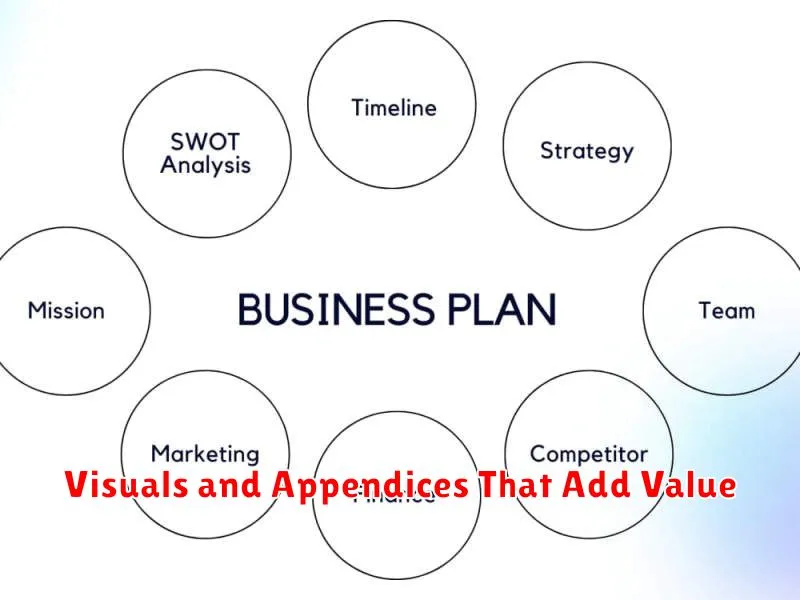
While a well-written business plan is essential, incorporating visuals and a comprehensive appendix can significantly enhance its impact on potential investors. Visual aids such as charts and graphs can make complex data more digestible and highlight key performance indicators (KPIs) and projections.
A strategically compiled appendix provides supporting documentation that strengthens your plan’s credibility. Include items like market research data, resumes of key personnel, permits and licenses, and letters of support or intent. This demonstrates thoroughness and provides investors with the detailed information they need to make informed decisions.
