
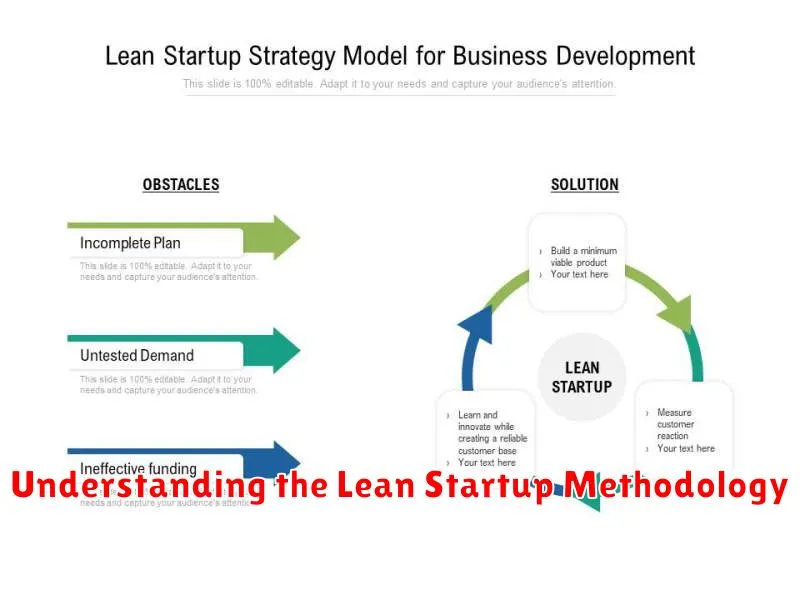
In today’s rapidly evolving business landscape, adopting a robust and adaptable approach to product development is crucial for success. The Lean Startup Methodology offers a powerful framework for navigating the uncertainties of launching new ventures and bringing innovative products to market. This methodology emphasizes iterative development, validated learning, and a focus on creating Minimum Viable Products (MVPs). By understanding the core principles of the Lean Startup Methodology, entrepreneurs and established businesses alike can significantly reduce risk, optimize resource allocation, and increase their chances of building successful and sustainable businesses. This article will delve into the key components of the Lean Startup approach, exploring how build-measure-learn feedback loops, innovation accounting, and a customer-centric mindset can drive growth and innovation.
The Lean Startup Methodology isn’t just a collection of buzzwords; it’s a practical and proven approach to building products that customers truly want. It challenges traditional business planning processes by encouraging experimentation and embracing failure as an opportunity to learn. This article will provide a comprehensive overview of the Lean Startup principles, offering actionable insights and practical examples to help you understand how to apply this methodology to your own projects. From identifying your early adopters to measuring key performance indicators (KPIs) and pivoting based on data-driven insights, the Lean Startup Methodology provides a roadmap for navigating the complexities of the modern marketplace and achieving sustainable growth.
What Is the Lean Startup Approach?
The Lean Startup approach offers a structured methodology for developing and managing new businesses, primarily startups, under conditions of extreme uncertainty. It prioritizes learning and rapid iteration over elaborate planning. The core principle revolves around the build-measure-learn feedback loop.
This iterative process emphasizes building a minimum viable product (MVP), a version of a new product with just enough features to attract early-adopter customers and validate product assumptions early on. The MVP is then released to the market to gather user feedback and data. This data is then analyzed to measure its effectiveness and learn what resonates with the target audience.
This learn phase informs the next iteration of the product, allowing for adjustments and refinements based on real-world data. The cycle repeats, enabling the startup to pivot its strategy or persevere with its current trajectory based on validated learning.
Minimum Viable Product (MVP) Explained
A Minimum Viable Product (MVP) is a development technique in which a new product or website is developed with sufficient features to attract early-adopter customers and validate a product idea early in the overall development cycle. The MVP’s final set of features is only determined after considering feedback from the product’s initial users.
The goal of an MVP is to test key assumptions about a product with minimal resources. By launching a simplified version first, businesses can gather valuable user data and iterate based on real-world feedback, rather than relying solely on market research and internal predictions. This reduces development costs and time-to-market, while maximizing learning.
Build-Measure-Learn Feedback Loop
The Build-Measure-Learn feedback loop is the core of the Lean Startup methodology. It’s a cyclical process that centers around validated learning. This means gathering empirical evidence to support or refute assumptions about your business.
The loop begins with the Build phase. Here, you develop a Minimum Viable Product (MVP) – a version of your product with just enough features to attract early-adopter customers and validate your core assumptions. It’s about building quickly and efficiently.
Next is the Measure phase. You gather data on how customers interact with your MVP. This could involve analyzing user behavior, collecting feedback, and tracking key metrics. The focus is on objective data, not opinions.
Finally, the Learn phase involves analyzing the data collected. Do your metrics support your hypotheses? If not, you’ve identified valuable learning. This learning informs your next iteration of the Build phase, restarting the cycle.
Customer Validation Techniques
Customer validation is a crucial aspect of the Lean Startup methodology. It involves rigorously testing assumptions about your product or service with real customers. This helps avoid building something nobody wants. Validating your assumptions early and often minimizes wasted resources and increases the chances of success.
Several techniques can be used for effective customer validation. Some common methods include customer interviews, where you directly gather feedback on your idea. Surveys are useful for collecting data from a larger audience. A/B testing different versions of your product can help determine which performs best. Finally, creating a Minimum Viable Product (MVP) and observing user interaction provides valuable insights into real-world usage.
Pivoting vs Persevering
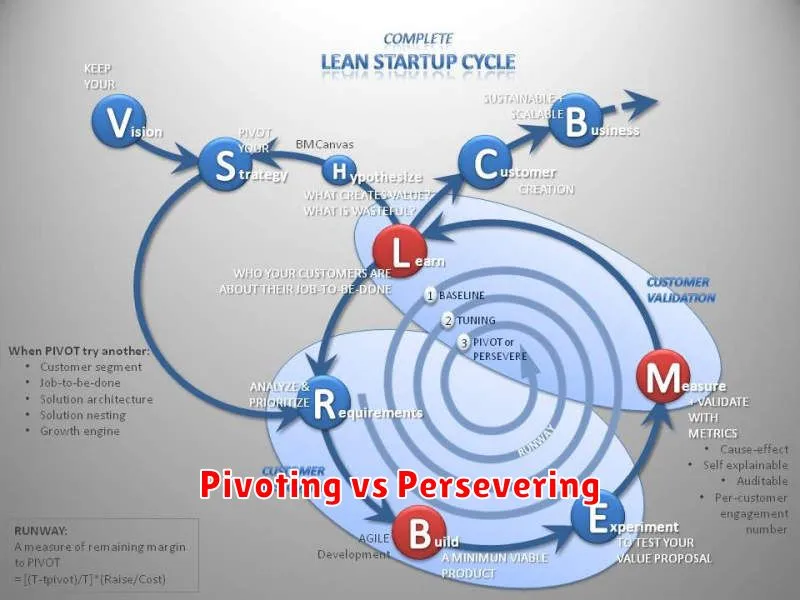
Two crucial concepts within the Lean Startup methodology are pivoting and persevering. Entrepreneurs must constantly analyze data and decide whether to stay the course or change direction.
Pivoting involves a structured course correction, altering some aspect of the business model based on validated learning. This might involve changing the target customer segment, the product itself, or the channel to reach customers. It’s not a complete restart, but a significant shift in strategy.
Persevering, on the other hand, means continuing on the current path, optimizing existing strategies based on feedback and data. This often involves iterative improvements to the product or marketing efforts.
The decision to pivot or persevere is a critical one, requiring careful consideration of market feedback, key metrics, and the overall vision for the startup.
Lean Canvas vs Traditional Business Plan
Choosing between a Lean Canvas and a traditional business plan depends on your context. A Lean Canvas is a one-page document that outlines key elements of a business model. It’s designed for speed and adaptability, ideal for startups in rapidly changing environments. The focus is on testing assumptions and iterating quickly.
Traditional business plans, on the other hand, are comprehensive documents providing a detailed roadmap. They’re more formal and structured, often required for securing funding from traditional sources like banks. They emphasize detailed market analysis, financial projections, and operational strategies.
A key difference lies in their purpose. Lean Canvas aims to validate a business model quickly, while traditional plans focus on planning for long-term execution.
Avoiding Waste and Overdevelopment
A core principle of the Lean Startup methodology is minimizing waste. This translates to avoiding unnecessary expenditures of resources, including time, money, and effort. Overdevelopment is a significant source of waste, where products or features are built that customers don’t actually need or want.
Lean Startups focus on developing a Minimum Viable Product (MVP). An MVP is a version of a product with just enough features to attract early-adopter customers and validate key business hypotheses. This iterative approach allows startups to gather crucial feedback early in the development process, preventing extensive work on features that ultimately prove unnecessary.
By prioritizing validated learning and continuous improvement, Lean Startups avoid large upfront investments in potentially unwanted features, minimizing waste and maximizing the efficient use of resources.
Measuring What Matters
At the heart of the Lean Startup methodology lies the build-measure-learn feedback loop. This iterative process emphasizes the importance of validated learning. Instead of relying on assumptions, startups should focus on gathering empirical data to inform their decisions.
Actionable metrics are key. Vanity metrics, such as website hits or downloads, can be misleading. Instead, focus on metrics that directly reflect the core value proposition and demonstrate progress toward key business objectives. These might include customer acquisition cost, customer lifetime value, or activation rate.
This data-driven approach allows startups to rapidly identify what’s working and what’s not, enabling them to pivot or persevere with informed confidence.
Real-Life Lean Startup Success Stories
Examining real-world examples helps solidify the Lean Startup principles. These successes demonstrate the power of iterative development, customer feedback, and the pivot.
Dropbox, initially a solution for personal file syncing, pivoted towards a collaborative platform after observing user behavior. This change, driven by validated learning, catapulted them to success.
Buffer, a social media scheduling tool, began with a simple landing page outlining proposed features. Gathering early user interest before building the product was key to their growth.
These examples highlight how focusing on the build-measure-learn feedback loop can lead to a product-market fit and ultimately, a thriving business.
Tools to Support Lean Execution
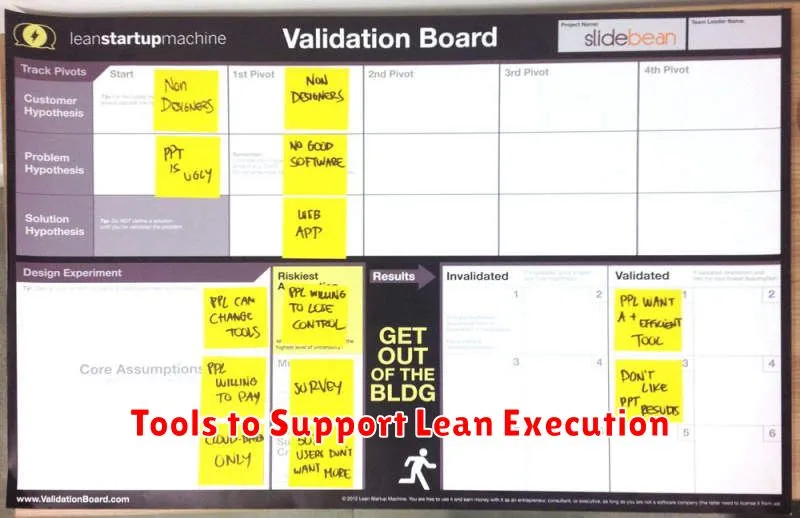
Several tools aid in implementing the lean startup principles. Build-Measure-Learn feedback loops are central to the process, and tools support each phase. For the Build phase, rapid prototyping tools and MVP development platforms are crucial. The Measure phase relies on analytics dashboards, A/B testing platforms, and user feedback collection mechanisms. Finally, the Learn phase utilizes tools for data analysis and visualization to derive actionable insights.
Utilizing these tools allows for faster iteration cycles and more efficient resource allocation, contributing to a data-driven decision-making process throughout the lifecycle of product development.
